What should social media platforms be doing about the spread of hate and misinformation, and how are they responsible to mitigate the use of our data for targeted posts and advertising?
Big data. We’ve all heard of it. And if you’ve kept an eye on the news, you’ve probably heard about some of the implications of it. We live in the digital age and every single person has a digital footprint- a stream of information that creates the most comprehensive profile of a person imaginable. In some cases, this big data lends to really beneficial outcomes for consumers. However, the switch from mass-marketing to micro-marketing and microtargeting has also opened the door for misdeeds and misinformation.
Even before microtargeting became a political issue, the internet has been home to political problems. Time and time again it has been proven that social media’s design inherently divides. This article from The Atlantic outlines the dark history of social media platforms. Jonathan Haidt and Tobias Rose-Stockwell describe how platforms have made it increasingly easy to share posts and how this, in turn, allows inflammatory posts (true or not) to achieve viral status.
Additionally, social media algorithms use big data to predict which posts will be popular to which users. This is NOT beneficial, because it narrows individuals’ worldviews- and often creates an even greater divide among those who already have polarized views. Pew research has collected data on partisanship and how the political realm has grown increasingly polarized over the years:
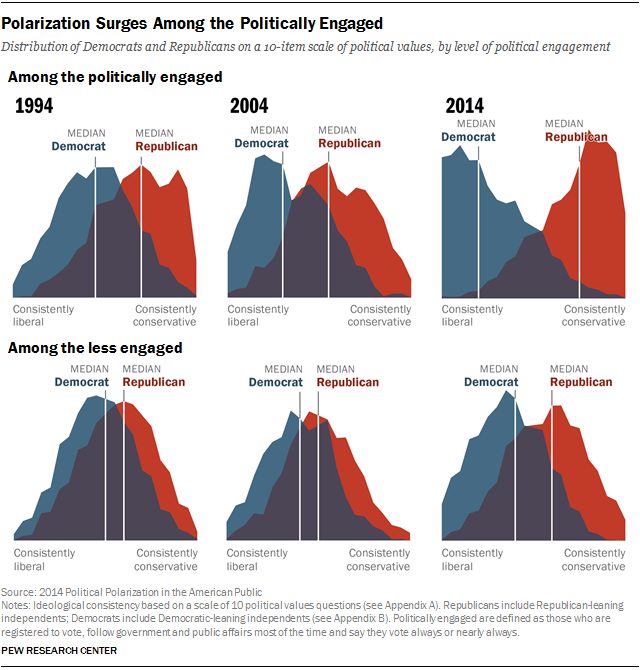
The divide between those who are actively engaged- presumably, those whose feeds would be curated to reflect their strong views- increased drastically between 2004 and 2014. Haidt and Rose-Stockwell
While it is important for candidates to be able to reach individuals who may identify with their platform, it is dangerous to use these individuals’ data to manipulate them.
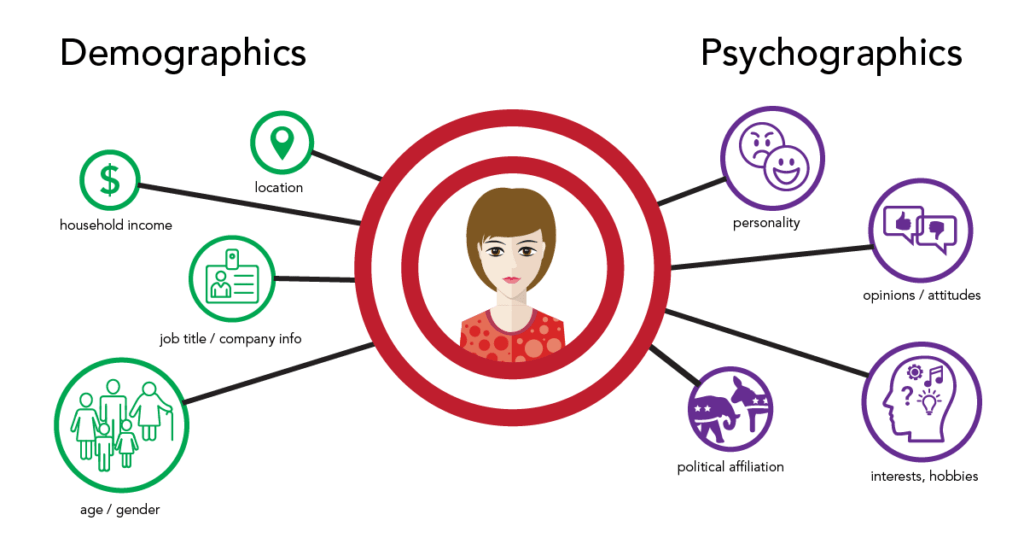
Psychographics are “market research or statistics classifying population groups according to psychological variables (such as attitudes, values, or fears).” They’re also what Cambridge Analytica used to help Trump win the election. The 2016 election is a prime example of the dangers of companies like Facebook allowing third parties to utilize user data. The CEO of Cambridge Analytica, Alexander Nix explained that through the data they collected they were able to create personality profiles “for every single adult in the United States of America.” By knowing what each individual values, for example, the Trump campaign could give them a different reason to support his stance on gun control. Even further, they could hand-pick topics that directly aligned with the user or struck a chord with them, which was easy since Trump’s stances and politics jumped around from day to day.
There are two sides to every story and this is ever true in the realm of targeted political ads. I previously mentioned how consumers benefit from algorithms and big data that is used to send them targeted ads. In the digital age, it is so easy to find a good deal on the “product we didn’t know we needed” or to find out about a flash sale on a site we love. Ultimately, both company and consumer benefit from micro-marketing. One journalist argues that using big data in politics also creates a beneficial connection, this time between political figures and their constituents. Despite the dangers of “fake news” and manipulation, journalist Chris Wilson believes in the utilization of microtargeted political ads:
“Every segment of the economy, not just campaigns, uses data analytics to communicate directly to their constituents, clients and customers. Addressing false ads in a free society does not require constraints on speech but rather transparency on the part of the advertiser, as Facebook now requires through full disclosure. In fact, with transparency, microtargeted ads are equally likely to be true as broadly delivered ads.”
“Getting rid of microtargeting in political advertising is a terrible idea.”
The key word that stands out to me in Wilson’s piece is “transparency.” Transparency may be one thing that keeps social media users vigilant. When the whereabouts of the information we are receiving are shrouded, it can be far too easy to accept something at face-value. If targeted ads have disclaimers about where they came from and what other information is available, they’d have the potential to be as beneficial as Wilson suggests.
Social media is an equalizer. I agree with Wilson that online ad campaigns can give newer politicians a chance to grow a base of constituents with whom the politician’s policies resonate. Perhaps transparency in the use of this tactic- a full disclosure of information- can enforce this beneficial world of microtargeting, unlike what the world saw with Trump’s election and the Cambridge Analytica scandal. Trump used contradictory messages in order to target and appeal to different voters. And since social media platforms generate such a narrow, customized user experience, it is likely that those users weren’t aware of how they were being manipulated.
If social media platforms took responsibility to uphold policies of transparency, I believe that a balance could be struck between the banning of microtargeting and the manipulation of it. The problem stems deeper, of course, into whether or not these companies are responsible for reinforcing users’ ideological tunnel vision even before the introduction of microgargeting.
What do you think about the role and responsibilities of social media platforms in regard to microtargeting?
 Modern Marketing Musings